How my Catholic, as well as Stoic and Zen thought, converge and diverge on the methods of sinful confession.
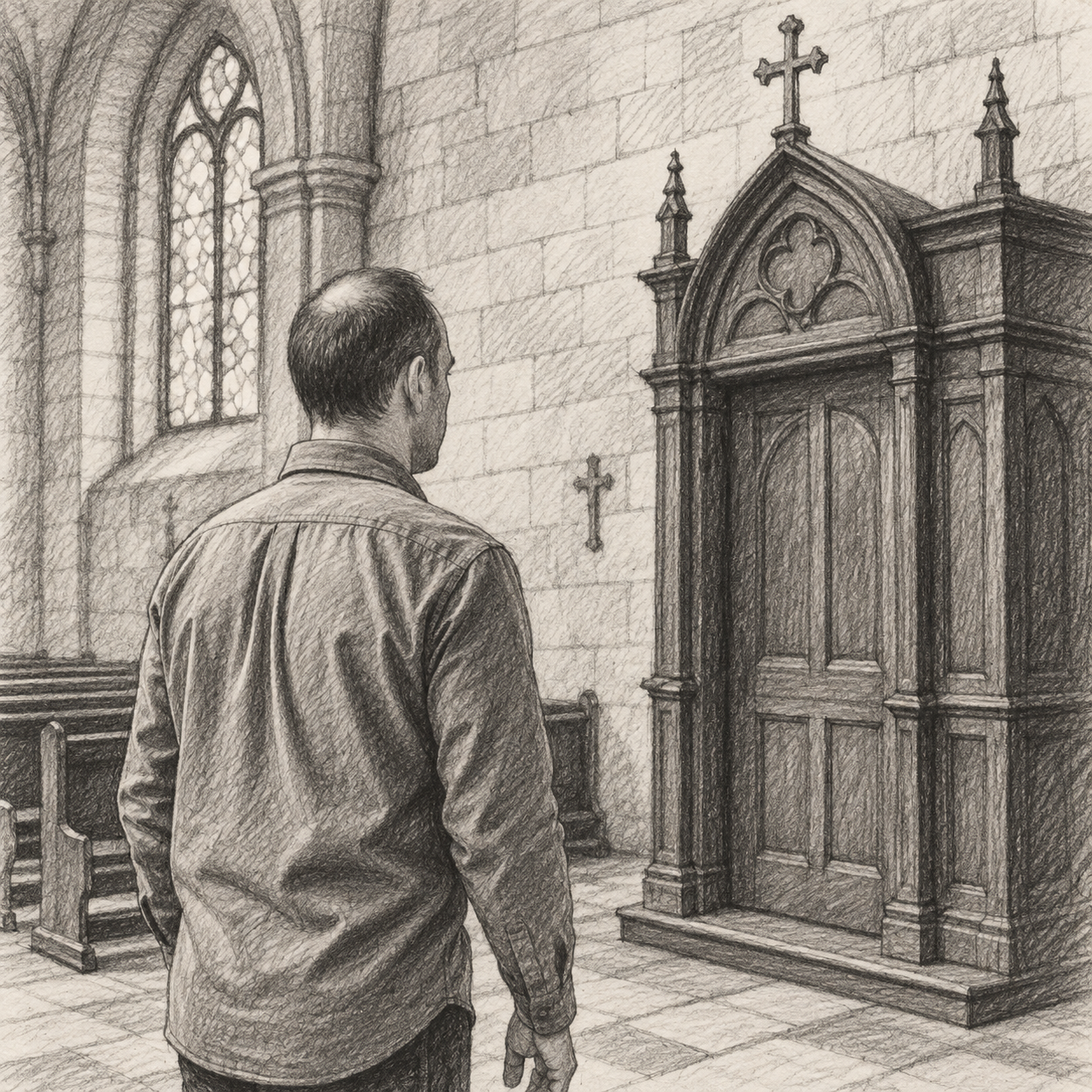
There is a moment in the confessional, after you kneel and before you speak, when you could still get up and leave. And even though I drive across town to confess to a Priest I barely know, I still wonder whether I should be there, whether the sacrament is relevant to me, or whether other ways can be just as absolving for self-correction and reflection.
Eastern Orthodox and Oriental Orthodox treat confession as a sacrament, which they call a Holy Mystery. The setting is different from the Catholic one. There is usually no booth or screen. The penitent stands before an icon of Christ, with the priest beside him as a witness rather than a judge. At absolution, the priest lays his stole over the person’s head. The emphasis leans toward healing rather than a verdict.
Anglicans and Episcopalians keep private confession in the Book of Common Prayer as the “Reconciliation of a Penitent.” It is optional, and their saying sums it up: all may, none must, some should.
- All may: All members of the church are welcome to private confession if they desire it.
- None must: The act is completely voluntary and not required for salvation or forgiveness.
- Some should: Recommended for individuals whose consciences are troubled, or those seeking specific spiritual guidance and healing.
Most Anglicans rely on the general confession said together during the service.
Lutherans kept private confession and absolution after the Reformation. Luther valued it highly, and some Lutheran writings count it close to a sacrament. In practice, it has become rare in most Lutheran churches, but it is not unheard of.
Most other Protestants don’t treat confession as a sacrament. They confess directly to God, without a priest. Many still lean on James 5:16, “Confess your faults one to another,” for accountability between believers. Early Methodism made this concrete: Wesley’s small “band” meetings had members confess their sins to each other weekly.
While I respect the other forms of Christianity, I’m Catholic, and I remind myself I can’t pick and choose what parts of the faith I will honor and which I won’t. And because it’s Catholic, you need a decoder ring to understand the various types of sins, the difference between venial and mortal sins, and which are covered by the receiving of the Eucharist and the Penitential Act, and which are not.
…Bless me, Father, for I have sinned. It has been “some time” since my last confession…
And then the hard part. Saying it. Being honest. Getting it off my chest. The moment of absolution from the sin and the feeling of being free, the equivalent of the IT Department asking you if you rebooted, and the moment Windows restarts.
But is all this required? It’s hard to follow archaic and arbitrary Catholic-centric rules when thinkers such as Seneca, Marcus, Epictetus, and Musashi approached this differently, yet all were highly ethical and of good moral standing. If I wasn’t going to confession, what would I do?
Ruthless Journaling:
Seneca kept a nightly habit. He went back over his whole day: What fault did I cure today, what temptation did I resist, in what way am I better? He weighed his words and his actions and, by his own account, hid nothing from himself.
I’ve discussed my concept of “ruthless journaling”: laying myself bare and raw on paper, exposing the parts of my life that are working and what is not. Instead of a gratitude prompt, I added to my daily journaling two elements: one promise to myself for the next day, and one action I regretted and one I was proud of, and the triggers I recognize that lead up to these actions. It seems like a lot, but it takes me less than five minutes, time recaptured by not scrolling.
Catholics call this the examination of conscience. Before you go into the confessional, you take inventory. Where did I fail God, my family, the people who depend on me? What did I do, and what did I leave undone?
Marcus did the same thing on paper. Meditations was never meant for us. It is Aurelius arguing with himself at the end of long days, holding his own conduct up to the light.
Western thought is something I understand, with Catholicism buried in every aspect of my life and education. Eastern Zen from Musashi offers similarities and differences worth highlighting. Musashi didn’t seek outside redemption from Man or God.
- Constant self-scrutiny in practice: The Book of Five Rings (1645) urges relentless examination of your own technique, habits, and mindset. You train, observe what fails, and correct it, “day and night.”
- Retreat and reflection: He wrote that book while living in a cave, reviewing a lifetime of duels and strategy.
- The Dokkōdō: A week before his death, he wrote 21 precepts summing up his self-discipline.
The key contrast is one of those precepts: “Do not regret what you have done.” Musashi examined his actions to sharpen future conduct, not to repent of past ones. Another precept, “Respect the gods and Buddhas without relying on them,” shows he sought no outside forgiveness either.
Loosely, the four approaches I’ve reviewed are:
- Catholic: examine, repent, receive grace.
- Stoic: examine, correct, begin again.
- Musashi: examine, refine, never look back.
- Anthony’s: Ruthless Journaling, Examination of Actions, seeking God’s forgiveness.
The Need for a Witness?
But the Stoics, and to a degree Musashi, did it alone, in the dark. No one heard. Written into a journal, is the resolution binding? Is something missing in this? Catholicism believes there is, the external witness.
A fault you admit only to yourself is still a negotiation. You are judge, defendant, and defense attorney at once. You can soften it, explain it, file it under circumstances. You can admit it every night for twenty years and never change a thing. I think we can all relate to an action we want to change in ourselves that we keep negotiating around.
The same fault, spoken aloud, becomes a fact. You hear your own voice say it. You can’t dress it up, because the priest on the other side of the screen has heard yours and better excuses before. You can’t take it back because it is already in the room.
That is the cost, and it is meant to be. Men who are used to being in charge, at work and at home, rarely kneel and say I was wrong to anyone. The confessional makes you do exactly that. Humility isn’t a feeling meant to be enjoyed; admitting weakness isn’t a strong man’s desire.
There is a personal cost to say your shortcomings out loud. A toll for anyone who wishes to be held in high regard, a white hat.
The divergence:
Seneca closes his nightly review by pardoning himself: see that you don’t do it again; this time I forgive you. He is the judge and the one who grants mercy. That is Stoic self-sufficiency all the way down.
When I put the journal down on my nightstand, I do the same thing as Seneca and the other Stoics: I go gentle on myself. After ruthlessly examining myself in words, I apply salve, be my own best friend, and resolve to do better next time.
Musashi didn’t dwell on regret, only on how he could be more precise going forward.
This is where my Catholic roots and adherence to the faith kicks in. I don’t absolve myself. I hear the priest say I absolve you from your sins, and the forgiveness comes from outside me. It’s the other side of the coin: the gentleness I give myself, coupled with the medicine God’s unending salvation provides. That is the difference between philosophy and faith.
But both agree on what matters most: It ends. You carry the pain and weight of mistakes no further.
I don’t believe in scarlet letters. I don’t need performative public airing of my sins. The priest I barely know gives me a penance to perform. A few prayers. I beat myself up far worse in the small hours when my mind won’t turn off. I understand those few prayers now. The point was never punishment. It was the clean break, a concrete act that marks the line between before and after.
Zen reaches the same place by a different road. In many Zen temples, practitioners chant a short verse of repentance. It owns all the harm done, born of greed, anger, and ignorance, through body, speech, and mind. It doesn’t itemize. It doesn’t argue. It takes full ownership, and then it sets the weight down.
Four methods. One discipline: own it completely, then let it go. All roads lead to the same place.
A week before he died, Musashi wrote down twenty-one precepts for the road he’d walked alone. One of them: Do not regret what you have done.
At first that sounds like the opposite of confession. It isn’t. Regret is what happens to faults that are never brought into the light. They stay in the dark and eat at you. They torment your sleep. They shape decisions years later. The man who never confesses doesn’t escape regret; he lives swimming in it.
Confession is the road to Musashi’s line, not a detour from it. You can’t put down what you’ve never picked up and looked at. Examine it, say it out loud, take the penance, walk out. Then, and only then, you have earned the right not to look back.
Catholics have always prayed for a good death, to go prepared, with nothing left unsaid. Musashi wrote his precepts with death in sight. Seneca reminded himself every night that the day might be his last. None of them wanted to die carrying something they could have set down. Neither do I.
You don’t have to be Catholic to live a good life; God knows better than us the evil committed in his name by the ordained class. No, have a method, have it mean something to you, honor it. The pathway to honor is to reject your own hypocrisy and unresolved regrets.
This essay first appeared on Anthony’s Substack. New essays land there first — subscribe for free to get them in your inbox.

